IeJSME 2017 11(1)
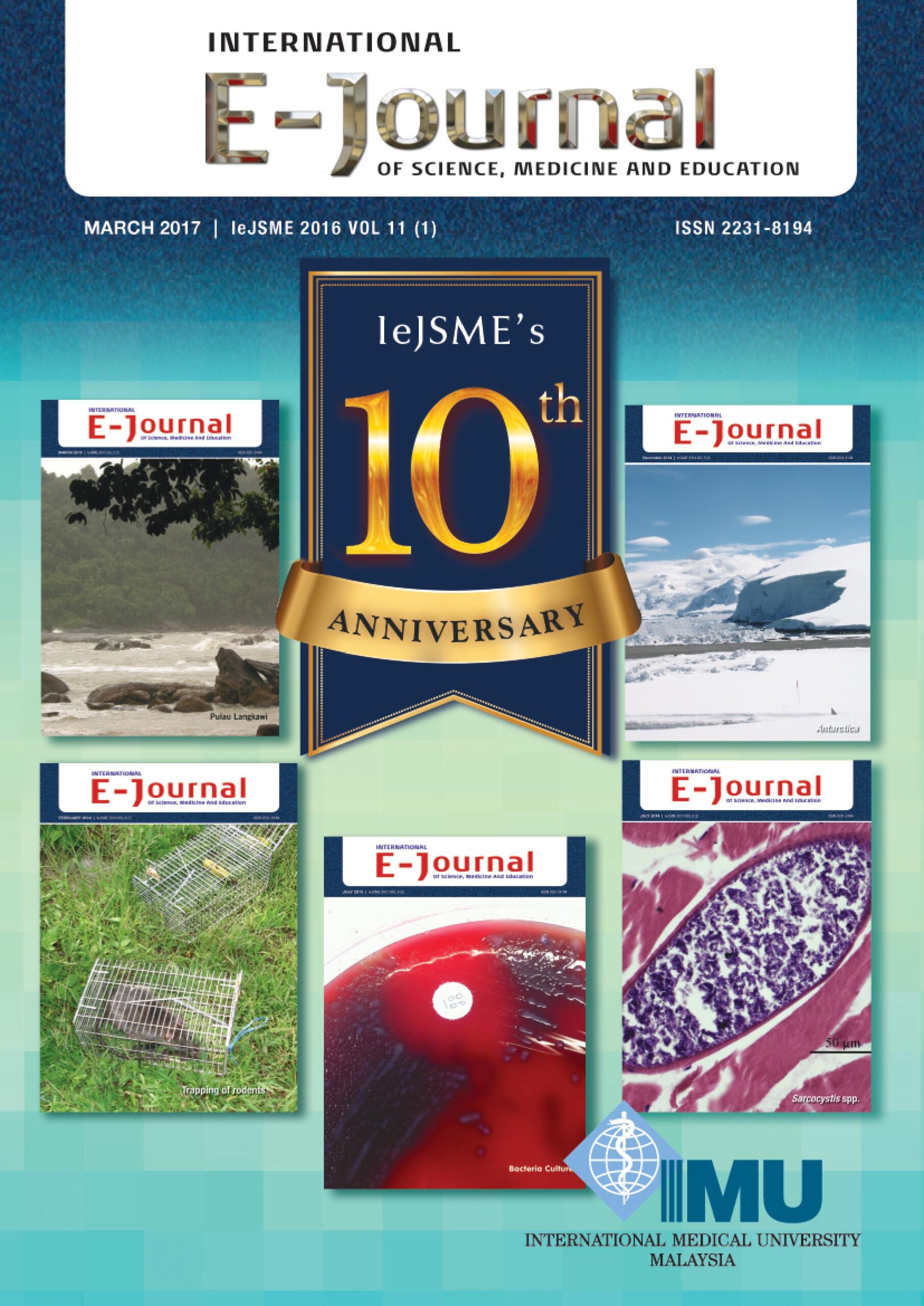

International e-Journal of Science, Medicine & Education (IeJSME)
International Medical University Malaysia
Author: Patricia Kim Chooi Lim
Keywords: IeJSME, 10th anniversary, journal, milestone.
Citation: IeJSME 2017 11(1): 1
Authors: Kavitha Nagandla, Sharifah Sulaiha, Sivalingam Nalliah, Norfadzilah Mohd Yusof.
ABSTRACT
Neuroendocrine carcinoma of the female reproductive tract are a heterogeneous group of rare neoplasms posing both diagnostic and therapeutic challenges. The recent classification by WHO includes neuroendocrine carcinomas (NECs) and neuroendocrine tumours (NETs). NECs are the poorly differentiated small cell carcinoma (SCNEC) and large cell neuroendocrine carcinoma (LCNEC), while well-differentiated NETs include typical carcinoids (TC) and atypical carcinoids (AC). Majority of these tumours have an aggressive clinical course and published data is supportive of multi-modal therapeutic strategies. Etoposide/platinum based chemotherapy is commonly advocated. Histopathological categorisation and diagnosis are paramount to guide therapy. Well-differentiated carcinoid and atypical carcinoid tumours should be managed similar to gastroenteropancreatic neuroendocrine tumours. This review discusses the current classification, clinicpathologic characteristics and advances in the diagnostic evaluation and the treatment options of neuroendocrine carcinoma of the cervix.
Keywords: High grade neuroendocrine tumours, well-differentiated neuroendocrine tumours, carcinoid tumours.
Citation: IeJSME 2017 11(1): 2-11
Authors: Wai Mun Tang, Tze Yee Wong, Cherish Chai.
ABSTRACT
Background: Positive physician-nurse collaborative relationship is the key determinant for patients’ outcomes.
Objective: The purpose of the study was to investigate registered nurses’ attitude towards physician-nurse collaboration and its association with demographic characteristics.
Methodology: The study was descriptive and cross-sectional. The data of the study was collected using the “Jefferson Scale of Attitudes toward Physician-Nurse Collaboration”. The sample size of the study was 127 registered nurses recruited using convenience sampling. Descriptive statistics and inferential statistics t-test were used for data analysis.
Results: The results showed that nurses’ attitude towards physician-nurse collaboration was positive (M=3.25, SD±0.29). The attitude of the participants was highly positive towards “shares education and collaboration” (M=3.42, SD±0.36), “nurse’s autonomy” (M=3.42, SD±0.44), and “caring vs. curing” subscales (M=3.41, SD±0.41). However, the participants rated lowest for “physician’s authority” subscale (M=2.12, SD±0.83) and particularly on the item “doctors should be dominant authority in all health care matters” (M=2.11, SD±0.99). Furthermore, t-test analysis revealed no significant association between nurses’ attitude towards physician-nurse collaboration and demographic characteristics such as age, gender, and educational level (p > 0.05).
Conclusion: The results of the study provided some crucial evidences on nurses’ attitude towards physician-nurse collaboration. The evidences are useful for the relevant stakeholders to initiate relevant strategies to improve and strengthen the relationship gap between physicians and nurses.
Keywords: Attitude, physician-nurse, collaboration, registered nurses.
Citation: IeJSME 2017 11(1): 12-20
Authors: Swee Geok Lim, Chian Yi Low.
ABSTRACT
Introduction: Perioperative care is nursing care provided by perioperative nurses to surgical patients during the perioperative period. Its role is important as patients especially those who had undergone coronary artery bypass graft (CABG) surgery encounter high levels of psychological and physical stress.
Objective: To determine the needs of CABG patients throughout the perioperative period and how well those needs were met.
Methods: This is a cross sectional descriptive survey. A total of 88 patients who had undergone coronary artery bypass graft were recruited through census sampling. The instrument which was adapted and used with permission for this study was “Survey of Patient Needs and Experiences during the Perioperative Period’ questionnaire (Davis et al., 2014).
Results: The patients perceived the perioperative needs in the post-anaesthesia care unit area to be the most important (M = 2.89, SD = 0.06). Perioperative needs which were rated the highest for each of the four time periods were “Having information about the surgical procedure itself”, “Having your family member or significant other with you in the pre-surgical area complications”, “Being treated with respect and with dignity by hospital personnel” and “Having your family member or significant other visit you in the recovery room”. Overall, patients perceived their needs during perioperative period to be partly met (M = 2.73, SD = 0.07) with post-anaesthesia care unit area being rated the highest (M = 2.81, SD = 0.06).
Conclusion: The results of this study highlighted the perceived needs of patients undergoing coronary artery bypass graft surgery throughout their perioperative period. In order to improve the quality of perioperative care for patients, nurses need to take into consideration the important needs identified by the patients and address the items which were not meeting the needs of the patients.
Keywords: Coronary artery bypass graft, Intra-operative care, Operating theatre, Perioperative care, Pre-operative care, Post-anaesthesia care.
Citation: IeJSME 2017 11(1): 21-32
Authors: Thiruselvi Subramaniam, Ann Jee Tan.
ABSTRACT
Background: House-officers and medical officers are at the forefront during medical emergencies in the ward and casualty which impose cognitive, communication, social and system challenges and yet, training in this area is commonly lacking. A workshop was conducted using simulation to provide training on some acute medical emergencies like cord prolapse, post- partum haemorrhage with collapse, poly-trauma and acute exacerbation of asthma.
Objective: To determine the effectiveness of simulation in developing competency in managing selected clinical emergencies
Methodology: There were 22 participants consisting of house-officers, junior medical officers and nursing clinical instructors. Only doctors were included in the study. Four medical emergencies were chosen viz.: Cord prolapse; post-partum haemorrhage with collapse; poly-trauma and acute exacerbation of asthma. The simulated sessions were conducted using high fidelity manikins and simulated patients. Simulated patients were trained and moulage was applied accordingly. The skills stations were on airway equipment and techniques of application, latest cardiac life support algorithm and hands on chest compression using manikins.
Results: A 5 point Likert scale used to rate the sessions. The skills station had 65% (n=13) rating as excellent and 35% (n=7) good. The skills simulation was rated excellent by 75% (n=15) and good by 25% (n=5) of participants. Verbal feedback was that it was very refreshing, informative, and helpful in terms of improving their skills.
Conclusion: The simulated skills training for the junior doctors was very well received and maybe beneficial for work preparedness and in the long run address patient safety.
Keywords: Junior doctors, medical emergencies, medical curriculum, resuscitation, simulation, work-preparedness.
Citation: IeJSME 2017 11(1): 33-38
Authors: Ren Yi Kow, Zamri Ab Rahman, Ruben Jaya Kumar, Zaharul Azri Mustapha@Zakaria, Chooi Leng Low.
ABSTRACT
Femoral nailing is the overall “gold standard” in treating femoral shaft fractures. However, plate osteosynthesis at the femoral shaft is still being done in selected patients. We report a case of right femoral implant failure after a broad limited contact dynamic compression plate (LC-DCP) insertion and its subsequent management using our minimally invasive technique. Our technique is biologically compliant as well as cosmetically friendly. We converted a load-bearing implant into a load-sharing implant in view that obesity is a significant predictive factor of non-union in a femoral fracture treated with locking plate. The patient subsequently recovered well with no complication.
Keywords: Implant failure, intramedullary nail, dynamic compression plate, femur fracture, obesity, minimally invasive.
Citation: IeJSME 2017 11(1): 39-42