Can parasites and their products provide therapeutic leads?
Author: Patricia Kim Chooi Lim
Keywords: Parasites, therapeutics, immunoregulators.
Citation: IeJSME 2019 13(3): 1-2

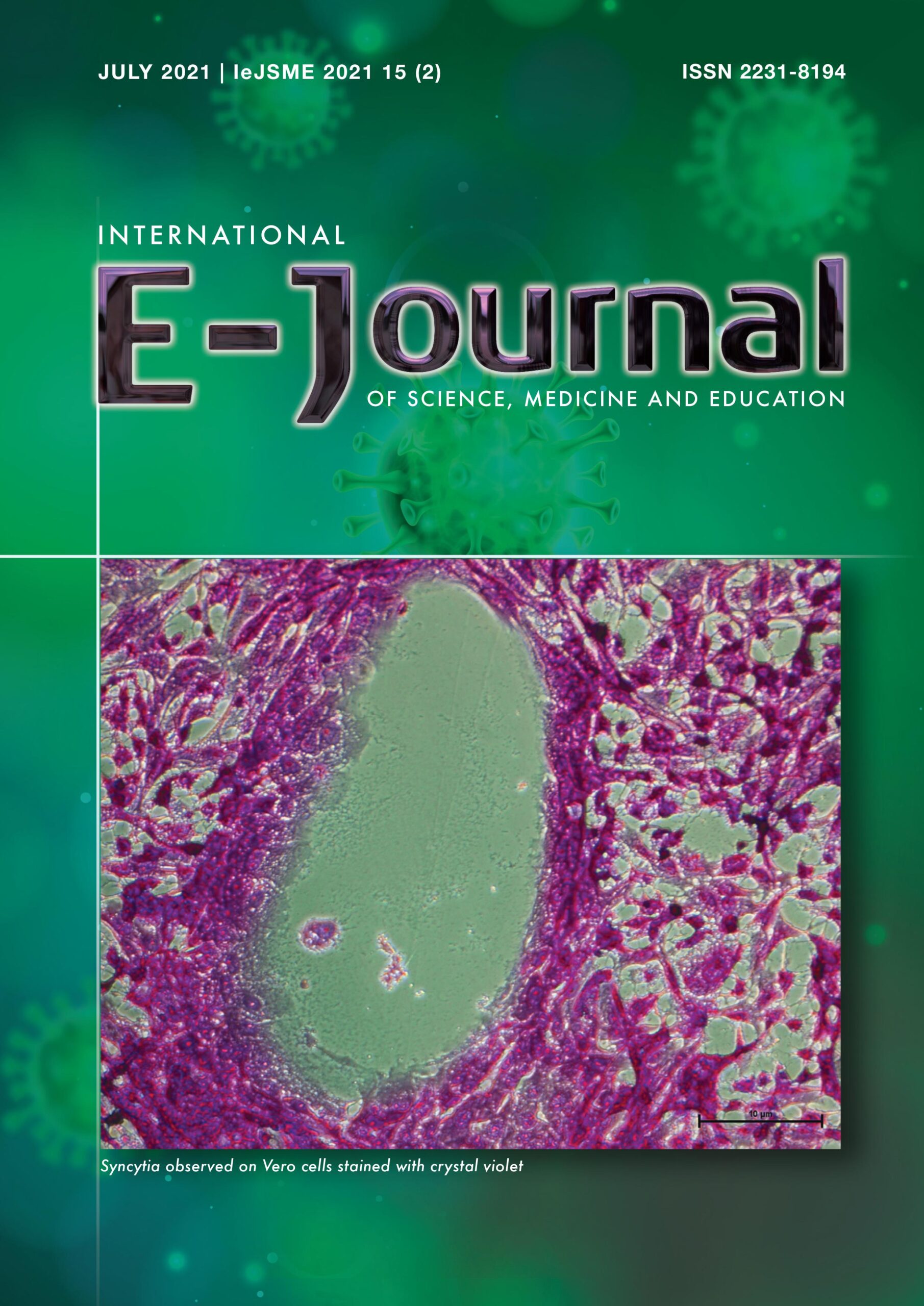
International e-Journal of Science, Medicine & Education (IeJSME)
International Medical University Malaysia
Author: Patricia Kim Chooi Lim
Keywords: Parasites, therapeutics, immunoregulators.
Citation: IeJSME 2019 13(3): 1-2
Authors: Ren Yi Kow, Mohd Jumaidi Md Hashim, Anas Nazha, Ed Simor Khan Mor Japar Khan, Chooi Leng Low.
ABSTRACT
Introduction: Solat or prayer, as one of the five pillars of Islam, is associated with bio-psycho-social benefits in Muslim patients. Many Muslim patients neglected solat while being hospitalized as they are unaware of the convenience (rukhsoh) available for them. Ibadah Friendly Hospital Courses have been conducted in different states of Malaysia to impart knowledge to the hospital staff who can in turn educate their patients. This study aims to construct a content-validated assessment tool to assess the effectiveness of a state-level Hospital Mesra Ibadah course.
Materials and methods: A self-administered questionnaire was constructed and content-validated by a panel of three experts (two religious teachers and one consultant spine surgeon). All 15 questions achieved item-level content validity index (I-CVI) of 1.00 after two rounds of validation. The questionnaires were distributed to participants of a state-level Hospital Mesra Ibadah course to compare the participants’ pre-course and post-course test scores.
Results: A total of 88 participants (48.9%) were included in this study. There was a significant difference in the pre-course test mean score and post-course test mean score among the participants. There was also a significant reduction of unsure answers after the course. There was no significant association found between the gender, place of work and occupation with the pre-post test score difference.
Conclusion: This study demonstrates that the Hospital Mesra Ibadah course is effective in imparting as well as consolidating the knowledge among participants, hence it should be routinely organized to benefit more participants.
Keywords: Prayer; Muslim; religion; medicine; quality of life.
Citation: IeJSME 2019 13(3): 3-9
Authors: Pei Kuan Lai, Chun Wai Mai, Lokman Hakim Sulaiman, Patricia Kim Chooi Lim.
Keywords: Healthcare, big data, analytics.
Citation: IeJSME 2019 13(3): 10-13

Authors: Patricia Kim Chooi Lim, Azizi Ayob, Khai Lone Lim, Shew Fung Wong, Kenny Voon, Lokman Hakim Sulaiman.
Keywords: COVID-19, SARS-CoV-2, pandemic, RT-PCR, diagnostic test.
Citation: IeJSME 2020 14(2): 1-4
Authors: Gerard Thomas Flaherty, Lydia Sze Teng Lee, Aida Lina Alias, Hasnain Zafar Baloch, Bryan Chang Wei Lim, Kok Leong Tan, Victor Lim, Lokman Hakim Sulaiman.
ABSTRACT
Introduction: Massive open online courses (MOOCs) are designed to accommodate large numbers of geographically dispersed learners. Few healthcare students receive exposure in travel medicine. We aimed as partner medical universities to develop a novel introductory MOOC in travel medicine suitable for undergraduate healthcare students, and to evaluate it among a cohort of learners.
Methods: A course development team, comprising a senior travel medicine academic from National University of Ireland Galway, local International Medical University faculty and instructional/graphic designers, was convened in November 2017. The MOOC proposal was subsequently refined. Course construction commenced in December 2017 and involved communication between team members based in Malaysia and Ireland. Lectures were recorded in January-July 2018. Development of learning and assessment material and the pilot phase were completed in December 2019. Course evaluation was based on the results of a questionnaire and qualitative free text comments from users.
Results: The MOOC is being delivered to a multinational cohort on a rolling basis. It is organised into five four-themed units: travel health risk assessment; pre-travel health advice; tropical infectious diseases;
specialised travellers; and illness in returned travellers. Pedagogical methods include short video lectures, journal articles, a discussion forum, and self-assessment quizzes. Learners have the option of completing an online test to receive a certificate of achievement. Participant evaluation from the first run of the MOOC has revealed very high levels of satisfaction with content and mode of delivery.
Conclusions: This is the first MOOC in travel medicine and it may provide a model for development of other collaborative international e-learning courses. It will address a significant deficit in undergraduate health professional education.
Keywords: Travel medicine, global health, MOOC, medical education, e-learning.
Citation: IeJSME 2020 14 (2): 5-25
Authors: Wei Fern Siew, Yen Ling Wong, Sheau Wei Lee.
ABSTRACT
Background: Physical examination in nursing practice is a systematic process of checking patients from head to toe using inspection, palpation, percussion, and auscultation techniques. This is part of a process to assist nurses in determining nursing diagnoses for patients’ care needs. A trained nurse with competent assessment skills can monitor treatment outcome and rapidly detect early signs of deterioration in patients.
Objective: The purpose of this study was to determine the perceived personal competence, the frequency of use of physical examination techniques, the factors that influenced physical examination practices and to identify training needs on physical examination skills among the registered nurses (RNs) in a selected private hospital in Malaysia.
Methods: This is a cross-sectional descriptive study. A self-reporting questionnaire was adapted with permission and pilot tested to ensure its suitability for use in this local study. A total of 154 registered nurses (RNs) from various clinical areas responded to this survey.
Results: The regularly used physical examination techniques by the RNs were mostly inspection and vital signs assessment. The frequency of physical examination skills used was higher among RNs with 4-5 years of working experience. Lack of time, role boundaries/scope of practice and ward culture were some of the factors identified that influenced nurses’ physical examination practices. Physical examinations of the cardiovascular, neurological and respiratory systems were the top three skills asserted as training needs by the RNs.
Conclusions: Inspection technique and vital signs checking are commonly practiced at ease by the RNs, but they perceived that they were least competent with palpation, percussion and auscultation techniques. Physical examination training is vital to ensure that the RNs keep their skills current in their nursing practice.
Keywords: Health assessment, perceived competency, influencing factors, training needs.
Citation: IeJSME 2020 14 (2): 26-37